Last week I was standing in front of my closet, holding one more pair of jeans I’d bought on a sale I don’t remember, and I realized I didn’t actually need a bigger wardrobe. I needed better rules.
So I did the thing I should have done a year ago: I fed the full archive of Joshua Becker’s Becoming Minimalist blog — 18 years of posts — to an AI and asked it a simple question. Which pieces of decluttering advice does he come back to again and again?
It makes sense, actually. If someone has been writing about the same subject for nearly two decades, the advice he repeats is probably the advice that survived contact with real life. The AI grouped similar ideas, ranked them by how often they resurface, and gave me a list of ten. A few I already believed. A couple surprised me. Here’s what it found.
1. Keep only what you need, use, or truly value
This is the baseline. It’s also the hardest part, because most of us own more than we need and we’ve trained ourselves not to notice.
Decluttering starts the moment you stop assuming everything in your closet deserves to stay, and start asking which pieces actually do work for the outfits you wear. Not the outfits you hope to wear someday.
2. Stop clutter before it enters your home
You can purge every single weekend and still end up exactly where you started if you keep buying on impulse. I know this from my own “just in case it goes on sale” shelf.
That’s why so much of Joshua’s writing drifts toward shopping habits. A closet that stays light only works if you learn to shop differently — fewer things in, fewer things to deal with later.
3. Start with the easy stuff
We tend to open with the hardest box. The sentimental stuff, the “maybe I’ll shrink into it” stuff. Don’t.
Start somewhere you can actually win. Clearing the junk drawer or the back shelf of deadstock builds confidence, and the decisions you practice on easy things make the hard ones feel less heavy.
4. Work through your home one area at a time
A whole apartment full of clutter will stop you before you start. So shrink the project.
One room. Or one closet. Or one shelf. Finish it, feel the difference, then move on. You don’t have to solve everything today — you just need to know what’s next.
5. Everything you own costs you something
The price tag isn’t the whole price. Every item takes up space, needs folding, needs attention, needs a home.
Joshua calls this the “clutter cost.” Once you see your possessions that way, “I might use it someday” becomes a much weaker argument for the item sitting on a wire hanger behind your best blazer.
6. Focus on what you gain by owning less
Joshua rarely frames minimalism as a competition to see who can own the least. The point is what becomes possible once the excess is gone.
More time in the morning. More room to breathe in your closet. More attention for the things that actually matter. It’s a lot easier to let something go when you know what you’re making space for.
7. Minimize before you organize
This one shows up constantly in his writing, and for good reason: organizing feels productive even when the real problem is untouched.
If you own too much, better boxes won’t save you. Fewer things will. Cut first, then sort what’s left — it’s dramatically easier that way.
8. Build habits that keep clutter from returning
A decluttered home isn’t maintained by one heroic weekend every spring. It stays that way through small daily calls — what you buy, what you keep, what you let pile up.
The goal isn’t to get better at clearing clutter over and over. It’s to build a home that stops producing so much of it in the first place.
9. Be suspicious of “just in case”
“I might need it someday” can justify keeping almost anything. Joshua challenges this one on repeat, because a possible future use is not the same as a real one.
There are things genuinely worth holding on to. But a quiet fear of needing something later has the power to fill an entire home with items you never touch. My sale-haul shelf was proof of that, and it’s gone now.
10. Give your possessions limits
Physical boundaries make hard decisions easy. A shelf tells you how many books fit. A closet tells you how many clothes it can actually hold.
Instead of endlessly hunting for more storage, try the better question: how much space do I want these things to take?
Over 18 years, Joshua has written about decluttering from every angle you can think of. These ten ideas keep surfacing in the archive anyway — that’s why I think they’re the ones worth starting with.
Quick FAQ
Why does he repeat the same advice? Because those are the ideas that held up over 18 years of testing them on real homes. Repetition is the signal.
Do I have to do all ten at once? No. Pick the one that stings least — usually the easy stuff, #3 — and let that build your momentum.
Is this about owning the fewest things? Not quite. It’s about owning only what you need, use, or value — the goal is what becomes possible when the excess leaves.
A note from Ava: I’ve been “planning to declutter” for years. The version that finally worked wasn’t a weekend purge — it was giving my closet a limit and trusting it. If you carry most of your stuff in a closet that’s already full, start there.
There’s a top in my closet, tags still on, that fits a version of me that somehow no longer exists. I’ve moved houses, seasons, and entirely different wardrobes, and it came along anyway. If you have that one hanger you can’t bring yourself to deal with, this is for you: what actually worked for me when it came time to let go of the things that no longer serve you, starting with what’s in front of your mirror.
Most of us know deep down we’re holding on to too much. Not just physical things, though there are plenty of those: the clothes we haven’t worn in years, the kitchen tools from a hobby we tried exactly once, the boxes that have moved with us from house to house without ever being opened.
Then there’s the less visible stuff. The commitments we outgrew. The version of ourselves we keep trying to get back to. The idea of who we were going to be the moment we bought something, or said yes to something we probably should have passed on.
Why letting go feels like losing a piece of yourself
Here’s the part that makes this harder than it should be. Psychologists have found that we absorb our possessions into our sense of self. The things we own stop being just objects and start feeling like extensions of who we are and what we value. So when you think about getting rid of something, it doesn’t feel like letting go of a thing. It feels like losing a piece of you.
That matters, because it explains why pure logic never quite works. You can know perfectly well you haven’t worn something in three years and still feel the pull to keep it. The pull isn’t irrational. It’s deeply human. It just isn’t always right.
The question that actually cuts through it
Do you love this? Most of us have tried that, and most of us still manage to wear the answer into a neat drawer. Do you use this? Better, but it still keeps the guitar that made sense for a version of you with Tuesday evenings free.
The question that works is more direct: does this belong in my life as it is right now? Not the life I used to live. Not the life I planned. The one I’m living today.
It has a way of making things clear. The formal wear you kept for occasions that stopped happening. The collection of something you once cared about deeply and simply don’t anymore. None of those things are wrong. Releasing them isn’t a betrayal of who you were. It’s an honest acknowledgment of who you are now.
Three things that finally made it doable
I’ve done a few decluttering rounds that lasted an afternoon and then quietly undid themselves. These three rules are what stuck for me.
1. The one-minute look
Hold a piece in front of the mirror. Can you picture wearing it this week, the way you actually live? If the honest answer is not really, and you can’t name one specific situation it would fit, it goes out before the week ends. One minute, in front of a mirror you trust, not in some fantasy version of your life.
2. The three-day box
Everything you’re unsure about goes into a box that stays out of sight. If you genuinely reach for an item in it within three days, it earns its way back into the closet. If you forget the box exists, that’s your answer. This is the one that got me past the impulse purchase that still has its tags on.
3. Forgive it, then let it go
Guilt is the sneaky one. The gift from someone who’s no longer here. The thing you kept because it was expensive, even though the money is gone either way. Clutter is often guilt made physical, and clearing it takes a kind of forgiveness of the purchase, of the circumstances, of yourself. Don’t ship anything out with guilt still attached to it. Let it go home to someone else, or donate it, and take a little note with you to remember the reason.
It’s not a loss. It’s editing.
Letting go gets easier when you stop thinking of it as loss and start thinking of it as accuracy. You’re editing your life to match who you actually are now, making your home a more honest reflection of your current values, your current season, your current self.
And it doesn’t have to be a total overhaul in an afternoon. One drawer. One shelf. One bag of stuff. You just need to start, and let the beginning do what beginnings do.
What you’ll find on the other side of letting go is not emptiness. It’s room. Room for the pieces that actually belong in your life right now. Room to breathe, to think, to be present without a background noise of stuff that still needs deciding. The things that no longer serve you aren’t serving anyone by staying. Let them go, and make room for what’s next.
— a note from Ava: the top with the tag is heading to the donation bin this week. The version of me it was bought for can finally clock out.
Thank you to Kohl’s for sponsoring this post. All opinions are my own.
I stood in front of my closet last week trying to figure out what to wear on a Friday where half the town is wearing red, white, and blue — but nobody wants to look like they’re in a parade float. Sound familiar?
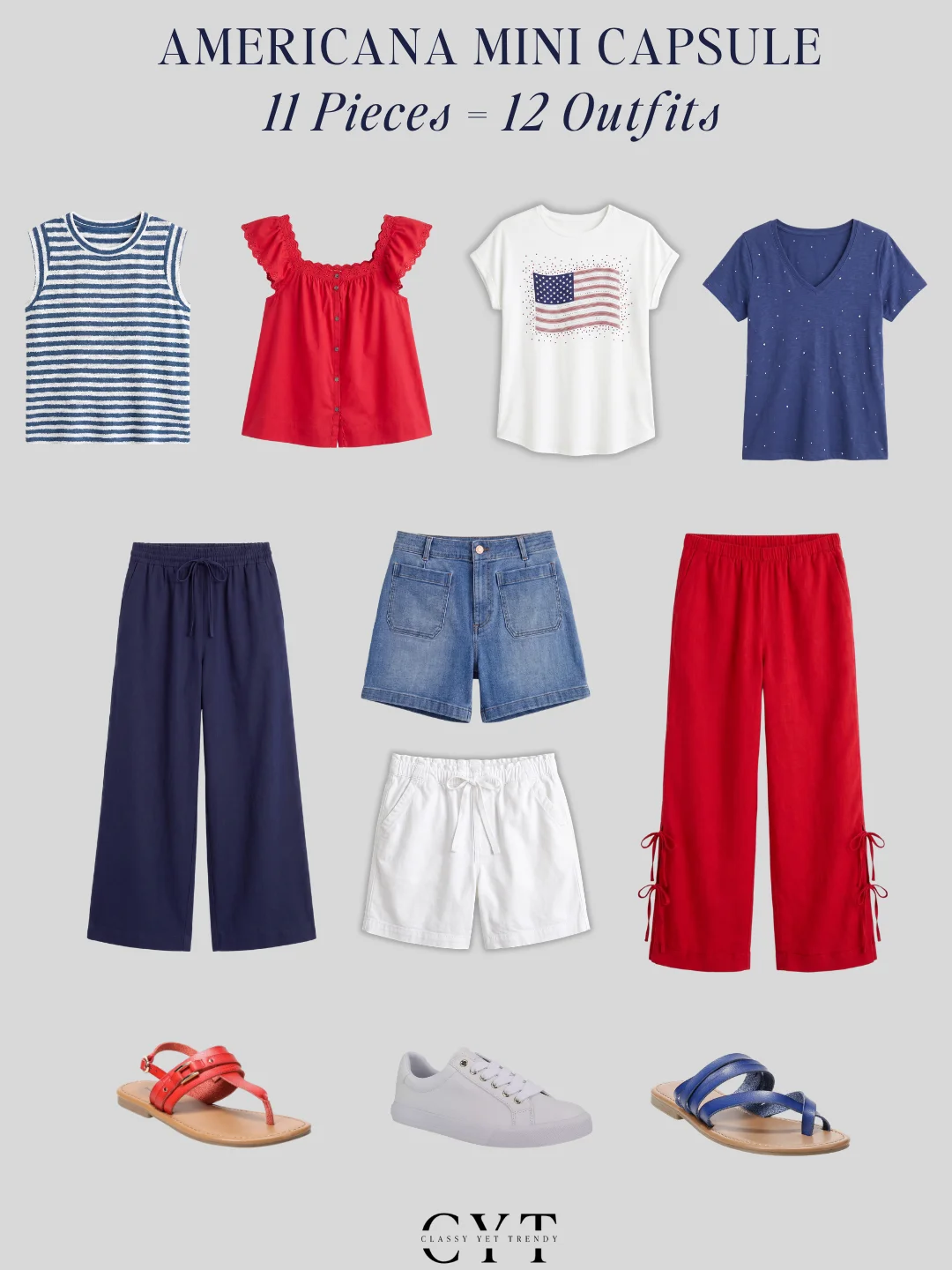
Here’s the thing: you don’t need twelve separate outfits for the Fourth of July weekend. You need eleven pieces that mix well.
This year marks America’s 250th birthday (yes, that’s the whole Semiquincentennial — I’m showing my age), and there are more parties, parades, and backyard barbecues than ever. I built a mini capsule in navy, red, and white. Everything is from Kohl’s because they carry brands like LC Lauren Conrad, Sonoma Goods For Life, Simply Vera Vera Wang, Croft & Barrow, Nine West, and Lee — all at prices that don’t make me flinch.
What I love about this capsule: the outfits work for July 4th, but nothing gets retired after fireworks. Swap in a different top or pair of pants from your regular wardrobe and you’ve got weekday looks through August. Pack it in a carry-on and it’s a travel capsule too.
The Pieces
Here’s what goes into the eleven-piece capsule:
Clothes and Shoes
A navy dress that works dressed up or down
A white button-down — linen-blend, no ironing drama
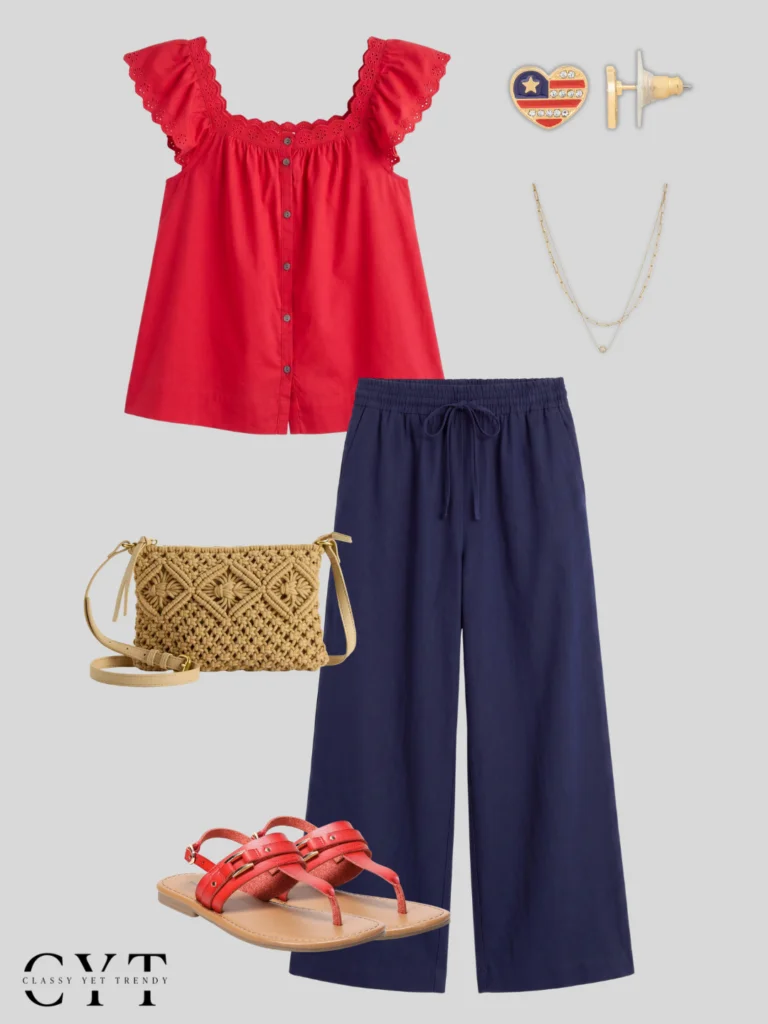
A red top (sleeveless for the heat)
Navy shorts with a flat front and room to breathe
White denim shorts that actually stay white
A striped tee in navy and white — reads as intentional, not casual by accident
An oversized blazer in navy or khaki for cooler evenings
Sneakers (white) and sandals (neutral) to switch the whole vibe
Accessories
A red crossbody bag that holds phone, keys, sunscreen
Simple gold jewelry — small hoops, a thin chain
A straw hat or baseball cap depending on the event
Sunglasses because it’s July
The blazer does most of the heavy lifting. Threw it on over a tee and shorts and suddenly you’re meeting someone for dinner instead of just grabbing ice cream.
12 Outfit Combinations
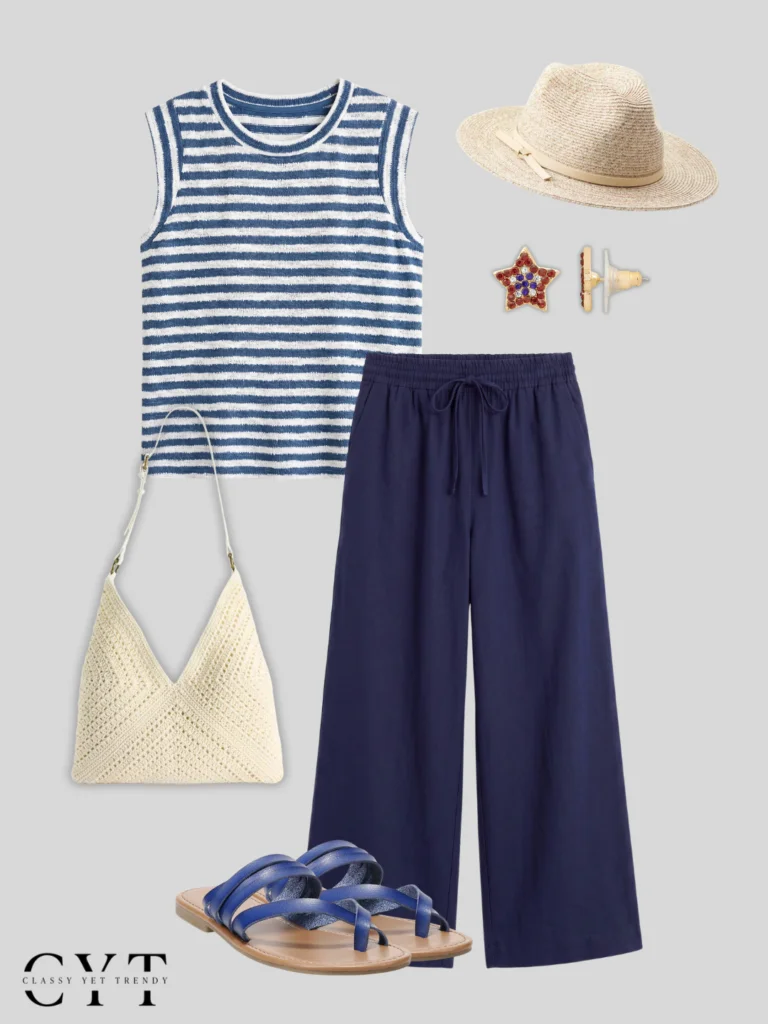
I mixed these eleven pieces into twelve looks. Here’s how they break down:
Outfit 1: The navy dress with white sneakers and a straw hat. This is my go-to for any daytime event — you show up looking put together without trying.
Outfit 2: White button-down tied at the waist over navy shorts, with sandals. The shirt adds structure; everything else is comfort.
Outfit 3: Red top, white denim shorts, and the crossbody bag. Straightforward patriotic look that doesn’t feel costume-y because the pieces are clean lines, not graphic tees.
Outfit 4: Striped tee with navy shorts and sneakers. The outfit you throw on when you’re running errands before heading to a party — it transitions without a full change.
Outfit 5: Navy dress layered under the blazer with sandals. Same dress as Outfit 1, just evening-ready now.
And seven more combos I styled: white tee + red skirt + sneakers; striped tee + white shorts + blazer + sunglasses; red top + navy pants + sandals; button-down untucked + denim shorts + crossbody; navy dress + sandals (no hat) for a simpler daytime look; blazer over the red top with white shorts; and the full casual set — striped tee, white shorts, sneakers, sunglasses.
Which one would you wear first?
A Few Tips
Mix proportions: pair fitted tops with relaxed bottoms. The capsule works because nothing is all tight or all oversized at once.
Use the blazer as a switch: it turns three casual looks into evening-ready outfits without adding a new piece.
Keep accessories simple: gold jewelry against navy and red reads polished. Overly ornate pieces compete with the color palette.
FAQ
Can I expand this capsule beyond 11 pieces?
Absolutely. Add a black top and navy pants, or swap in different colored shorts from your closet. The framework stays the same — neutrals plus one accent color that you rotate.
Will these outfits work for travel?
Yes. Eleven pieces fit easily into a carry-on. I’d roll the tees, fold the blazer on top, and pack shoes in a bag at the bottom. You get twelve looks from one suitcase.
I don’t wear red — can this capsule work for me?
Swap red for any color that pairs with navy and white: olive, mustard, or even black. The structure is the same; only the accent changes.
A note from Ava: I made this capsule while reorganizing my closet on a Tuesday morning. Halfway through, I realized I already owned six of these pieces — just never put them together. Sometimes the best outfits are hiding in your own drawers.
I was standing in an airport security line last month, juggling my passport, a laptop bag, and a water bottle I’d definitely forgotten to empty. The woman ahead of me was trying to untie her hiking boots with one hand while holding her boarding pass in the other. I felt that familiar pang of empathy — and then slipped mine off without breaking stride.
That’s what travel clothing is supposed to do: get out of your way. Not look like a fashion editorial, not demand attention. Just work.
I’ve been traveling full time for 20 years now, since my first around-the-world trip back in 2006. Thousands of flights later — from sweltering Southeast Asia to the freezing approach into Reykjavik — I know what travel clothing actually needs to do. It’s about function, comfort, and durability. Everything else is bonus.
So what makes a piece great for the road? And how do you pack it without hauling your entire closet?
Comfortable, Yes. Pajamas, No
I’ve noticed something annoying lately: people treating long-haul flights like they’re heading to bed instead of across the world. Full flannel pajama sets, fleece onesies — I get it. Flights are exhausting.
But there’s a middle ground between restrictive clothing and looking like you just left your bedroom. Modern travel pants — merino joggers or technical stretch trousers — feel like sleepwear but still look put-together when you walk off the plane. The goal is simple: dress comfortably enough to rest, presentable enough that if your luggage gets lost, you could still grab a coffee without changing.
What Makes Great Travel Clothing
Six things I look for in every piece:
Pockets. Zippered ones are non-negotiable.
I’m genuinely that excited about pockets. Side pockets — one zippered, one not — plus hidden compartments for your passport or phone. Security and convenience go hand-in-hand.
In 20 years of full-time travel, I’ve never used a money belt once. They just add bulk to your middle, and who wants that? Plus I rarely carry cash anymore anyway.
My favorite trick: Royal Robbins dresses and pants with cleverly hidden compartments. Perfect for city wandering or border crossings where you need quick access but don’t want everything on display.
Wrinkle-resistant fabrics
Ironing is not on my travel itinerary — I don’t even own an iron at home. Clothes that can be balled up in a backpack and still come out looking decent? That’s the standard.
Royal Robbins’ Spotless collection has been my go-to for this. The materials somehow bounce back smooth without any hotel steam wand involved.
Stretch
You never know when you’ll sprint to catch a train or scale an unexpected staircase in some centuries-old European hotel. Stretchy fabrics make the difference between comfort and misery — especially on long-haul flights, bus rides, and train trips.
I always wear stretchy travel pants with pockets whenever I’m sitting for hours. Non-stretch fabrics dig into your waist, tighten around your knees, or feel restrictive as your body naturally shifts during travel. Stretch adapts to you.
Breathable and temperature-regulating
If you’ve ever worn jeans in Vietnam, you already know this one. Natural fibers like merino wool, alpaca, bamboo, hemp, and organic cotton regulate temperature and wick moisture better than synthetics.
Smartwool is my pick for base layers and tees — they keep you cool when it’s hot and warm when it’s chilly, with minimal odor buildup.
Slip-on shoes
Slip-on shoes remove friction in travel — literally and figuratively. They simplify airport security and make daily transitions easier, which matters more than you’d think until you’re juggling all that stuff.
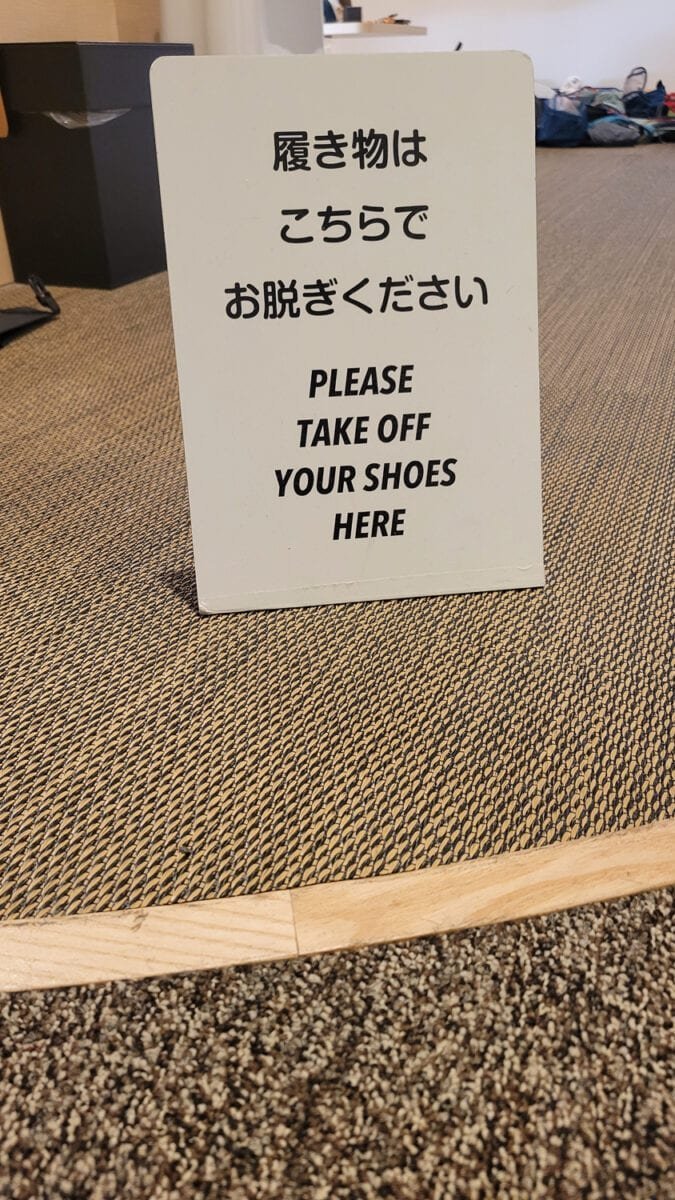
They’re also essential for Japan and parts of Southeast Asia where you’ll be expected to remove your shoes regularly. Slip-ons make the process seamless without the awkward balancing act of untying laces multiple times a day. Kizik makes slip-on tennis shoes with patented heel technology, so they’re dead simple to slide on and off.
Versatility
Nothing gets me more excited than something that does double duty — like reversible leggings, or a scarf/pashmina that works as a blanket on the plane, a shawl at dinner, and a beach cover-up by afternoon. Every dual-purpose item reduces what you need to pack.
Compression Socks (Don’t Skip Them)
I never board a flight or train without compression socks. After experiencing a blood clot years ago following a long flight, they became non-negotiable for me.
Beyond the medical benefit, they help with swelling and fatigue — especially on those marathon travel days. And they’re not just for sitting: I use them for hiking and biking too. They reduce muscle fatigue and speed recovery.
My go-to brand is VIM & VIGR. They make compression legwear that actually looks good — unique patterns, seasonal drops — so you feel like a traveler, not a patient.
How to Pack It All: Capsule Wardrobe Basics
The real magic isn’t in the pieces themselves — it’s how you pack them. A capsule wardrobe is just a curated set of mix-and-match clothing that works for any destination. Here’s my system:
Stick to 2–3 base colors, plus 1–2 accents
Black, navy, gray as your foundation. Then add one or two accent colors through scarves and jewelry. These small items are lightweight, take up almost no space, and instantly dress up a neutral outfit.
Layer light, not heavy
Dump the sweaters. A merino tank plus a long-sleeve layer plus a compressible down jacket covers most climates. That down jacket can also double as a pillow on the plane.
Limit yourself to three pairs of shoes
I know this one’s hard, but here it is: one for walking (sneakers or supportive sandals), one for hiking or adventure (trail shoes or boots), and one nicer pair (flats or low-profile sneakers) for dinners. Sometimes your supportive sandals can double as the nicer pair.
I often use trail running shoes that handle both walking and hiking — two jobs, one pair.
Packing tips that actually work
Use packing cubes or compression bags. They turn your suitcase into a portable dresser instead of a black hole. I organize by category — shirts in one cube, pants in another, underwear and socks in their own. No more exploding your entire suitcase on the hotel bed to find one t-shirt. My favorite is the Thule Compression Cube Set (around $47) because it combines organization with compression in one.
Roll your clothes. I’ve been doing this since 2006. Rolling works hand-in-hand with packing cubes — it makes clothes more compact, reduces wrinkles, and lets you see each item instead of stacking things on top of each other and forgetting what’s in the bottom.
Wear your bulkiest clothes on the plane. Hiking boots are heavy and bulky. I wear them for the flight so they don’t eat up suitcase space. Doesn’t always work perfectly — you can’t wear boots 24/7 — but every ounce saved counts when you’re carry-on only.
Don’t forget a hat (or two, or three). They resolve bad hair days after a long flight and the inevitable wait until hotel check-in at 4 PM. Great sun protection for sightseeing and outdoor activities. And they can instantly dress up an outfit in a capsule wardrobe. I normally take 2 or 3 hats per trip.
Wallaroo makes great quality packable sunhats — their entire line folds down small enough to stash anywhere. To transport wide-brimmed hats, I use a Klipsta clip attached to my carry-on when I’m not wearing them. A carabiner works for baseball caps.
The Fabric Question: Natural vs Synthetic
Fabric is the foundation of great travel clothing. The best options regulate temperature, resist odors, dry quickly, and stay comfortable after repeated wear.
Best natural fabrics:
Merino wool — odor resistant, temperature regulating, breathable
Alpaca wool — warmer than merino for its weight, lightweight, highly insulating
The best travel clothing usually blends natural and synthetic to maximize all three: comfort, durability, and performance.
Brands I Actually Trust
Clothing styles change every year, so rather than listing specific products that’ll be outdated in a season, here are the brands that consistently put out great travel pieces:
Royal Robbins was built specifically around travelers’ needs. The brand was founded by Royal and Liz Robbins — legendary climbers and early adventure travelers who understood what it means to live out of a backpack. Their clothes tick every box: versatile, wrinkle-free, breathable, stretchy, pocket-plentiful, lightweight. And they’re a little dressier than typical adventure travel clothing, which works well for business-casual destinations too.
Smartwool has come far beyond socks. Their full lineup uses merino wool — one of my favorite travel fabrics, period. Temperature regulation, odor resistance, moisture management. You can wear a Smartwool base layer on a flight, hike all day, and wear it again the next day without worrying about smell.
Kühl balances performance and style perfectly. Their FREEFLEX collection is water resistant with stretch that rebounds — maintains its shape even after hours of sitting. The material is incredibly soft, like wearing pajamas on a long-haul flight, but they look smart enough for dinner. I have multiple pairs of their travel pants.
Outdoor Research leans toward outdoor adventure, but most adventure gear has exactly the qualities you want in travel clothes: wicking, stretch, lightweight, quick-dry. Their jackets are my favorite layering pieces — from lightweight puffy vests to heavy-duty parkas that handle wind, rain, and freezing temps.
PAKA uses alpaca wool sourced directly from Peru — warmer than merino for its weight, breathable, naturally odor-resistant. Beyond performance, their commitment to sustainability is impressive: fully recyclable packaging and a traceability program where you can track each garment back to the exact alpaca it came from.
Old Navy — yes, really. For cheap, simple travel basics like tank tops and t-shirts, Old Navy is hard to beat. Sometimes you just need something affordable and functional. I’ve always liked their basics; maybe it’s because I worked at Gap during my corporate career. Who knows.
Why Investing in Quality Travel Clothing Is Worth It
High-quality travel clothing lets you pack less while doing more. Instead of separate outfits for flights, hiking, sightseeing, and dining, you rely on fewer versatile pieces that handle all four.
The benefits add up: lighter packing (carry-on only), greater comfort on long travel days, less frequent laundry, better durability over years of use, and more versatility across climates. Over time, quality actually saves money because you need fewer pieces and replace them less often.
Final Thought: Comfort Over Cute
You want to look good in photos — I get it. But no one looks cute when they’re sweating through polyester or limping from blisters. Invest in the pieces that do the work for you. They should breathe, stretch, resist wrinkles, and make you feel ready to explore… comfortably.
And whatever you do, don’t forget the compression socks.
What is travel clothing?
Travel clothing is apparel designed specifically for comfort, versatility, and functionality on the road. It typically includes wrinkle-resistant fabrics, stretch, breathable materials, odor resistance, and secure pockets — everything that makes long flights, sightseeing, hiking, and carry-on travel easier.
What fabrics are best for travel?
Merino wool, alpaca wool, nylon blends, polyester blends, bamboo, and hemp. These regulate temperature, resist odor, dry quickly, and stay comfortable during long stretches of sitting or walking. The best pieces usually blend natural and synthetic fibers.
How many outfits should you pack?
Most travelers only need 3–5 tops, 2–3 bottoms, 1–2 layering pieces, one versatile dress (optional), and one jacket. A capsule wardrobe approach lets you mix and match those into multiple outfits.
A note from Ava: I used to pack a separate outfit for every scenario — flight clothes, hiking clothes, dinner clothes — until I realized the same stretchy dark pants worked for all three. My suitcase got lighter that day, and my mornings got easier. If you carry most of your weight below the waist, you know the struggle of finding travel pants that don’t pinch after a long flight. The ones with real stretch are worth every dollar.